A New API Product Line for Whoop
Digital health is a rapidly expanding market. Digital health companies also pose a rapidly expanding product opportunity for Whoop. I interviewed leadership at a bunch of these companies, sketched out their problem and product requirements, and proposed a solution we can sell them. Here's what it might look like:
Customer Profile
Companies like Omada Health, Maven Clinic, Teladoc, and Hinge Health have ballooned since COVID to fill a $250B market. Patients feeling underserved by traditional healthcare turn to these companies, which provide personalized, mostly online care, from mental health to geriatrics to women's health to skincare to biohacking. By going online, providers save on costs of care, while patients get personalized healthcare from the comfort of their homes.
As a result, most of them start out directly selling to patients. However, they soon pivot to the biggest buyers of health: B2B customers like health insurance plans, employers, and traditional healthcare providers. They give out digital health subscriptions as perks to their patients/employees/users, expecting them to improve their patients' health while cutting overall healthcare spend.
The relationships look something like this: {{passToC:true}}
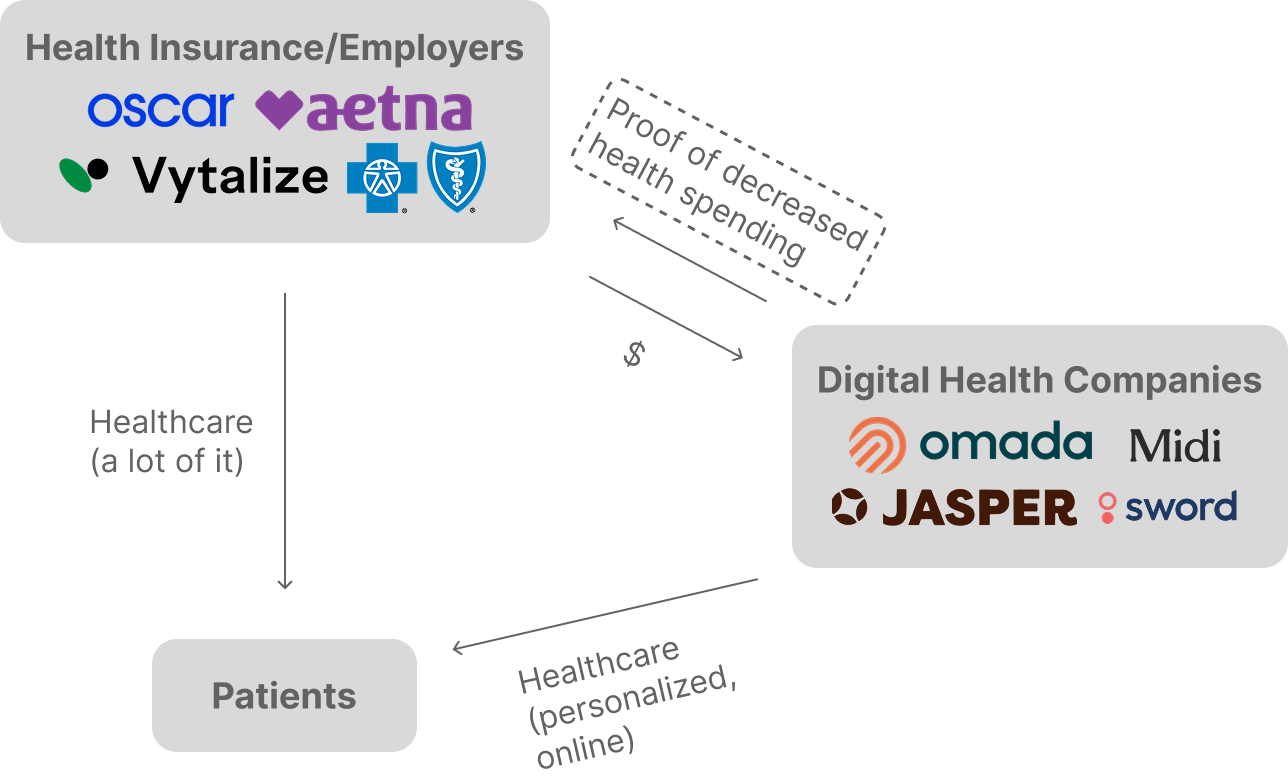
Companies that pay for healthcare—mostly health insurance plans + employers—want to cut their costs. So they outsource some care to digital health companies, in return asking for proof that they're actually cutting their total spend.
Problem
Digital health companies don't have this proof. Many (but not all!) successfully attack chronic health issues before they become severe, avoiding expensive care like hospitalization or hospice down the line. But because they work so far up the chain of cause and effect, there hasn't yet been a reliable way to measure their impact.
Among many other executives I talked to, Andrew Parker, CEO of Papa, echoed this. Papa is a unicorn that matches older adults with companions ("pals"), and its customers pay for it to reduce healthcare costs: combating loneliness can help avoid expensive health issues. Andrew told me that these customers constantly ask for proof of cost savings. But Papa’s effects are intangible and don't show up on an itemized hospital bill. Digital health companies need a detailed understanding of their users’ health (which we can offer them!) to prove their value to customers.
Solution Requirements
| Requirement | Story |
| Proof of Health | User: I want solid proof that I’m making patients healthier, so I can satisfy the health insurance plans that buy my services. |
| Proof of Cost Savings | User: I want solid proof that I'm lowering overall healthcare costs, for those same health insurance plans. |
| Portability | User: I want a solution that plugs into the whitelabeled analytics platform (Explo, Power BI, Innovacer) I’m already giving my customers. |
| Applicability | User: I want a solution that shows the value of my specific treatments (mental health, chronic disease management, women’s care). |
| Nonintrusivity | User: I want a solution that doesn’t involve invasive testing or lab visits for patients. |
| Remote | User: I want a solution with an at-home, concierge experience. |
Users need portable, nonintrusive data that shows when their patients get healthier.
Whoop's Solution
A paid Whoop API to prove that digital health improves health outcomes. We already track a litany of metrics—many of them 24/7—to give users a detailed picture of their health. Meanwhile, digital health companies can’t access day-to-day information about their patients. Why not sell them this picture?
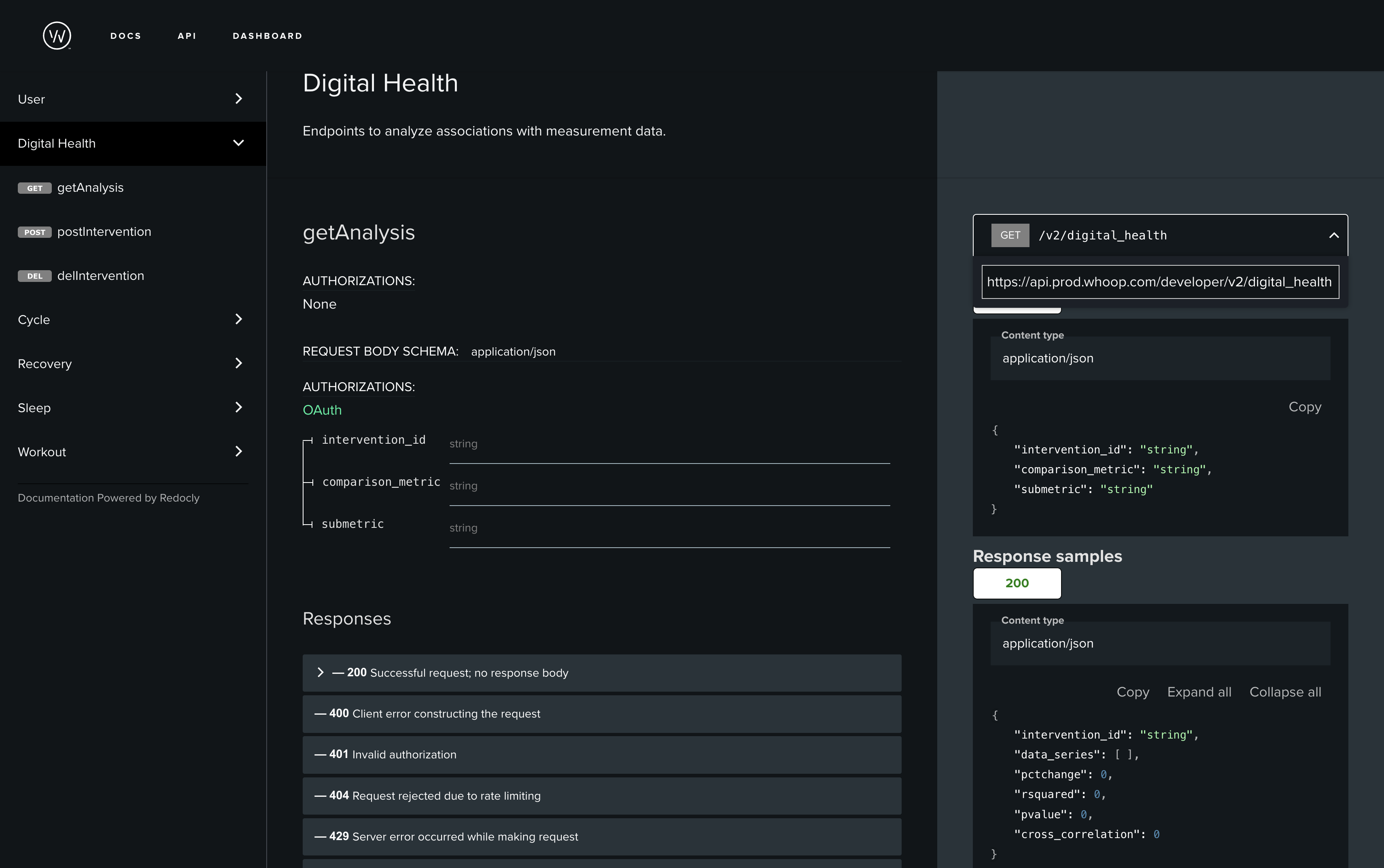
New API endpoints would build on our existing free-to-use API. If digital health companies do their jobs, they will measurably improve our metrics—sleep quality, recovery, blood pressure insights—using our API to prove that their patients are healthier. I've created some example endpoints, shown below, that help companies find correlation between their interventions and patients' health.
Patients need to have and wear Whoop for this to work. Luckily, there's significant overlap in the target demographics of Whoop and of digital health companies: young to middle-aged technophiles in search of digital products to optimize their health. Many of them may already be using Whoop! For those who aren't, we can offer B2B pricing and bundle Whoop subscriptions with the API.
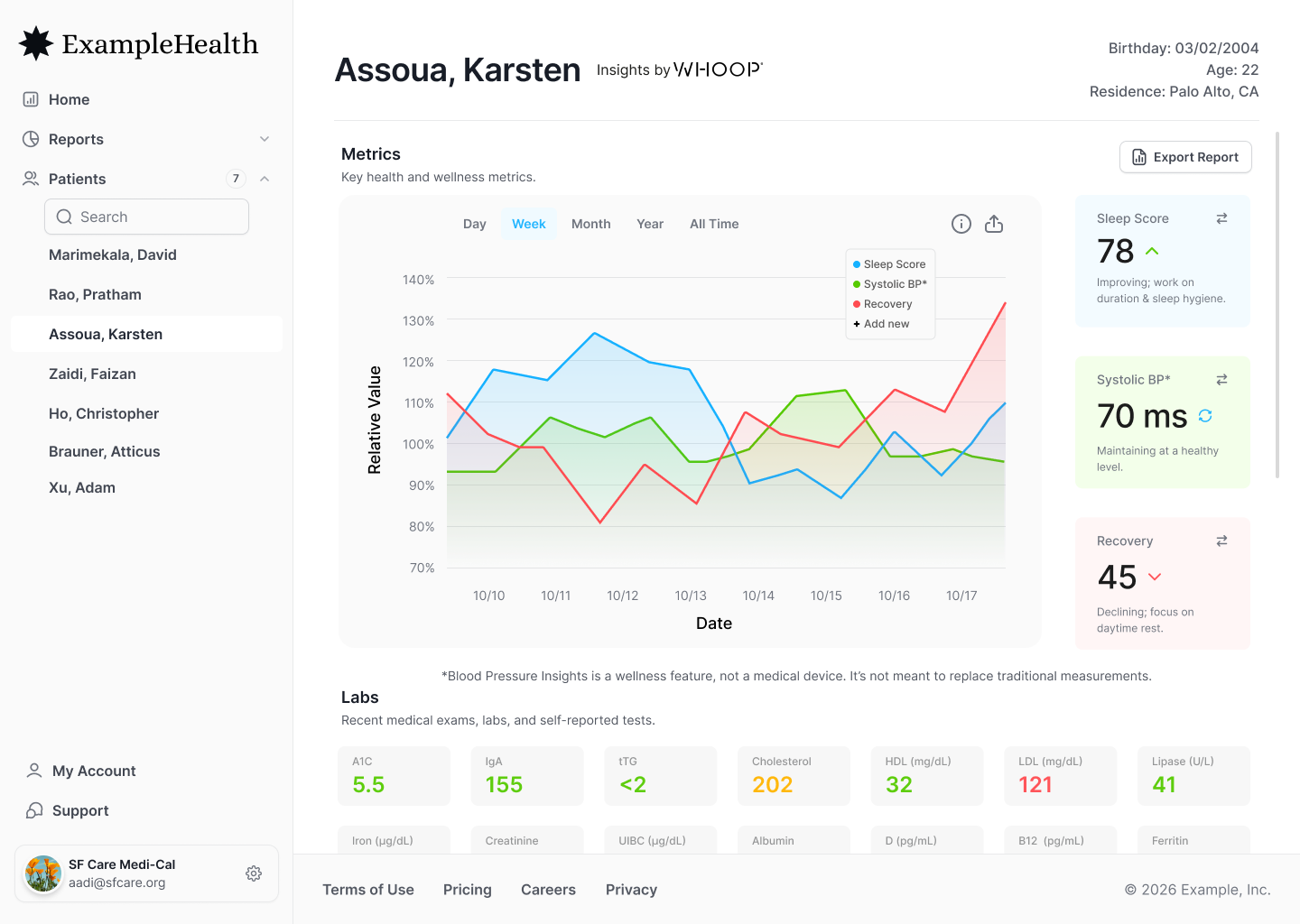
Here's an example of a dashboard that uses this API to show off health improvements: {{passToC:true}}
A potential user is (Amazon's) One Medical, where I talked to Wendy Hepker, director of High Risk Care. On top of their regular remote care, they implemented home visits for high-risk patients to great success—they caught many issues overlooked by traditional healthcare, like minor wounds and fall hazards.
But these visits were also a huge added cost. If Wendy needed to prove the value of home visits to her B2B customers, she could use our API to track improvements in health + estimate how many expensive hospital visits they avoided.
KPIs
There's a good chance that this solution doesn't work. Maybe most digital health companies don't even improve their patients' health, so our metrics are useless to them. Maybe they're developing cheaper in-house patient tracking, and don't need ours. We need to hit these rough KPIs to make sure it's working.
| Indicator | Target | Justification |
| New API keys generated | 20/month | There are a few hundred digital health companies. If they have this problem, they will take up our API quickly. |
| CAC | Zero | Acquisition costs for an API should be negligible. All the uptake work will be done by developers at our customers. |
| Usage (API calls per key) | 10% monthly growth | Resource-intensive uptake for APIs means that growth will be slow, but consistent. |
Market Opportunity
Here's a back-of-the-envelope estimate of how big this solution could be.
Digital health companies (aka digital therapeutics) have ~30% user penetration in the US. That means that about 100 million people have access to these products. Let's say 5% actively use them, so we have 5M active users of digital health in the US. Let's estimate our B2B pricing at 1/2 of Whoop One → $100/user/year. That gives us a $500M market opportunity.